Sports Supplements Guide: From Creatine to Caffeine
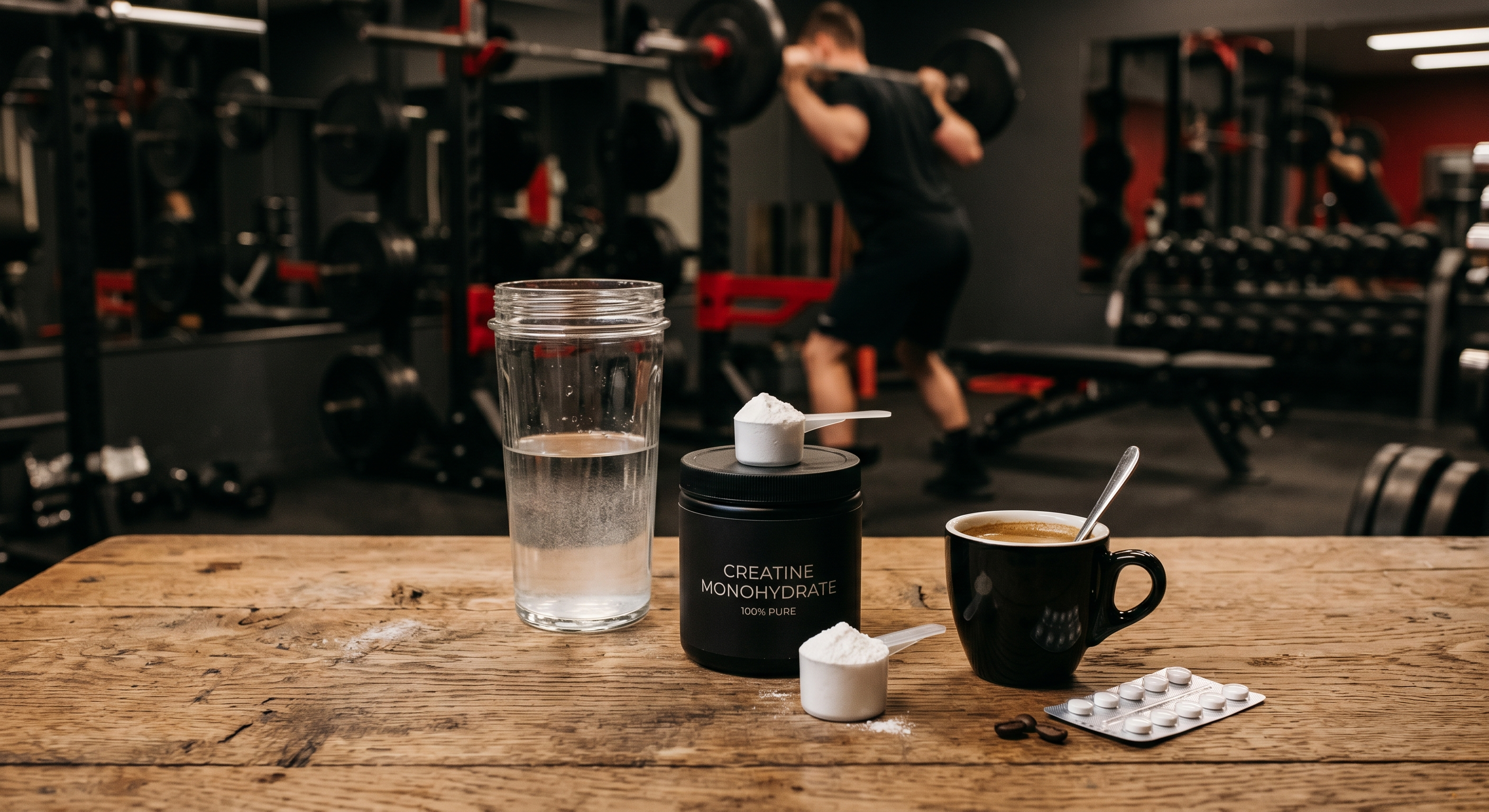
Walk into any gym or scroll through social media and you'll see dozens of supplements, all promising dramatic results. The reality is far simpler: the number of supplements with strong scientific evidence can be counted on one hand. The rest are either under-researched or primarily marketing-driven products.
In this guide, we evaluate the most popular sports supplements by their level of evidence, outline who can benefit from them and how much, and flag what to watch out for.
1. Creatine Monohydrate
Creatine is the most studied supplement in sports science literature — and one of the most consistently effective. It increases phosphocreatine stores in muscle cells, supporting energy production during short, high-intensity efforts (sprints, heavy lifts).
- Can improve strength and power output by roughly 5–15%.
- Supports long-term muscle mass gain by enabling progressive load increases.
- A loading phase is unnecessary; 3–5 g per day taken consistently is sufficient.
- Long-term use is safe for individuals with healthy kidney function.
2. Protein Powder (Whey / Plant-Based)
Protein powder is not really a supplement — it's a food convenience tool. Reaching your daily protein target (1.6–2.2 g per kg of body weight) through whole foods alone isn't always practical. Protein powder fills that gap efficiently.
Whey protein's fast absorption and high leucine content make it particularly effective at stimulating muscle protein synthesis. For those who don't tolerate lactose, plant-based blends (pea + rice) can achieve a similar amino acid profile.
3. Caffeine
Caffeine is one of the few substances shown to delay fatigue and improve focus across both endurance and strength training contexts. It works by blocking adenosine receptors in the brain.
- 3–6 mg/kg before training (~210–420 mg for a 70 kg person) can enhance performance.
- To avoid tolerance build-up, use on training days rather than every day.
- Can disrupt sleep; afternoon intake should be approached carefully.
- High doses (>9 mg/kg) carry serious side effects and must never be exceeded.
4. Beta-Alanine
Beta-alanine raises muscle carnosine levels, buffering acid build-up and delaying fatigue. Its most noticeable benefit is during high-intensity efforts lasting 1–4 minutes (intervals, high-rep sets).
The most common side effect is skin tingling (paresthesia). This is harmless but can be uncomfortable. Splitting the dose (2–4 g/day in two portions) reduces this effect.
5. Vitamin D and Magnesium
These two micronutrients are among the most commonly deficient in athletes. Vitamin D deficiency is directly linked to muscle strength, immune function, and mood. Magnesium plays a role in hundreds of enzymatic processes; deficiency is associated with muscle cramps and poor sleep quality.
Before supplementing either, we strongly recommend getting a blood test and consulting a healthcare professional. Excess vitamin D intake can be toxic.
6. BCAAs and EAAs: Are They Actually Needed?
Branched-chain amino acids (BCAAs) and essential amino acids (EAAs) provide no additional benefit for individuals already consuming adequate protein. If you're consistently hitting your daily protein target through food (eggs, meat, dairy, legumes, protein powder), there's no reason to spend extra on BCAA/EAA products. These become relevant mainly when protein intake is insufficient or during extended fasted training sessions.
Tracking beats supplementing — every time
Even the best supplement stack can't replace consistent, measured training. Regardless of what you take: if you don't know how much you lifted, how many sets you completed, and how that compares to last week, you can't evaluate your progress.
VIGOR logs your sets, reps, and weights for every session, giving you the data to see what's actually working. Core tracking is free for life.