How Much Sleep Do You Need to Build Muscle?
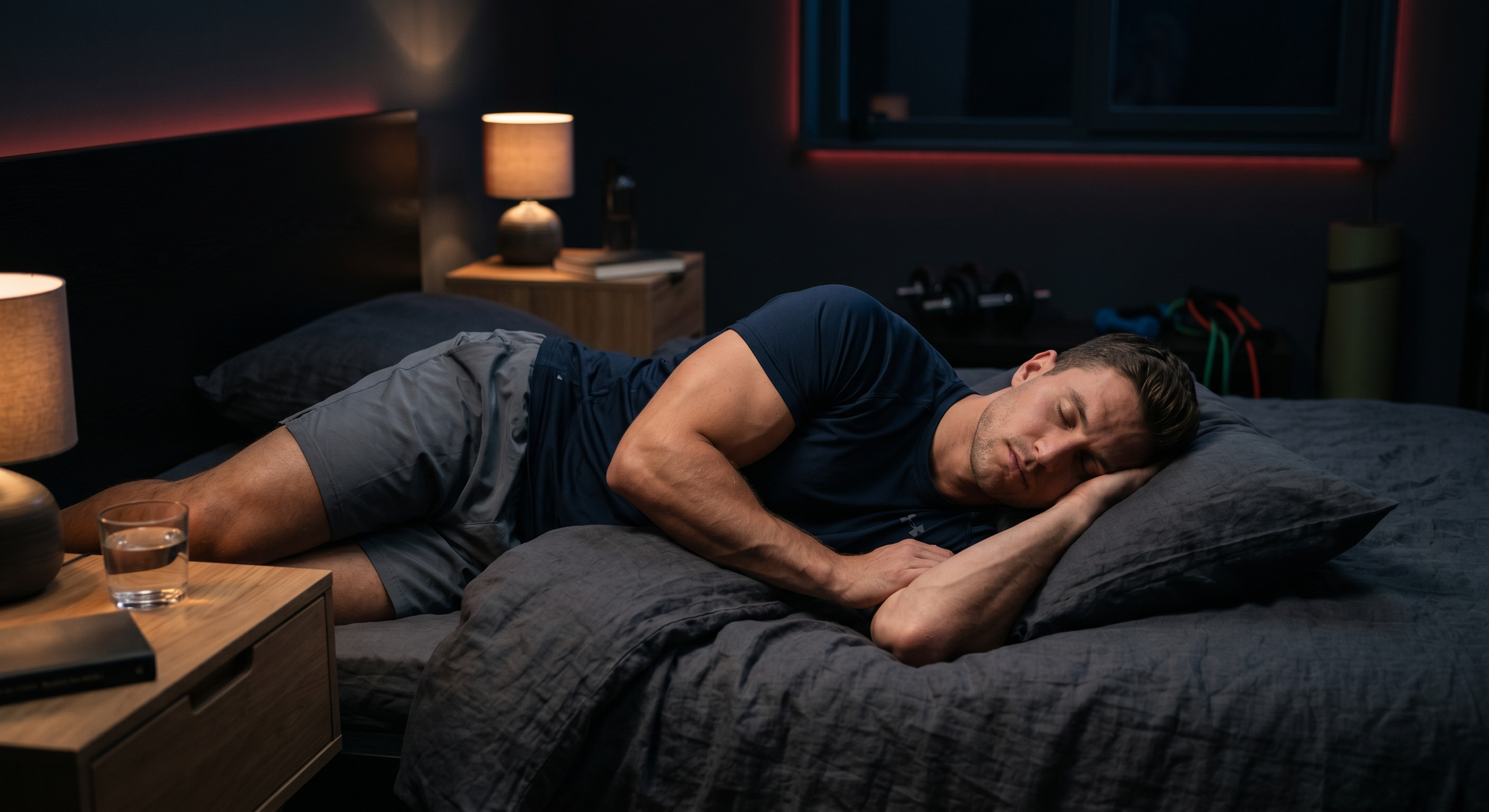
Everyone knows training and nutrition drive muscle growth. Sleep is rarely treated with the same seriousness — even though, mechanically, it may be more important than both. You don't build muscle in the gym. You build it while you sleep.
What Happens to Your Muscles While You Sleep
During deep sleep — specifically slow-wave sleep — your pituitary gland releases approximately 70% of your daily growth hormone. This is the primary anabolic window: damaged tissue is repaired, muscle protein synthesis continues, and the adaptations triggered by training are consolidated.
At the same time, cortisol — the catabolic hormone that breaks down muscle tissue — drops to its daily low. The longer and better you sleep, the longer this protective window lasts. Interrupt sleep, and you interrupt both processes.
How Much Is Enough
The research is consistent enough to give clear numbers:
| Who | Recommended sleep |
|---|---|
| General population | 7–9 hours |
| Athletes in heavy training | 8–10 hours |
| Under 6 hours | Measurably impairs recovery and hormonal balance |
But duration is only part of the equation. A fragmented 8 hours with multiple interruptions doesn't deliver the same slow-wave sleep — and therefore the same growth hormone output — as an uninterrupted 7. Quality matters as much as quantity.
What Sleep Deprivation Does to Your Gains
- Testosterone drops. A week of sleeping under 6 hours reduces testosterone levels by roughly 10–15% in young men. Testosterone is critical for muscle protein synthesis and recovery speed.
- Cortisol rises. Short sleep elevates cortisol, which accelerates muscle breakdown and impairs the anabolic response to training.
- CNS output falls. Your ability to generate force — to actually push hard — is tied to central nervous system recovery. Poor sleep means lower output, even if you don't feel it acutely.
- Injury risk increases. Reaction time, proprioception, and decision-making all decline with sleep loss. You move worse, and you're less likely to notice it.
Signs Your Recovery Is Falling Short
Under-recovery isn't always obvious. Watch for these signals:
- Persistent soreness that doesn't resolve between sessions
- Progress stalling despite consistent, hard training
- Unusual fatigue before workouts even start
- Motivation that feels lower than your training load warrants
- Weights that normally feel manageable suddenly feel heavy
These aren't signs you need to train harder. They're signs you need to recover better.
Practical Ways to Improve Sleep Quality
- Keep a consistent sleep/wake time — including weekends. Your circadian rhythm responds to consistency far more reliably than to duration. Sleeping in on weekends shifts your internal clock and makes Monday harder.
- Keep your room dark and cool. Core body temperature needs to drop to initiate sleep. A cooler room (around 18°C) accelerates this process.
- Avoid screens 30–60 minutes before bed. Blue light from screens suppresses melatonin production and delays sleep onset.
- Don't train within 2–3 hours of sleep. Intense exercise raises both core temperature and cortisol levels — both of which delay sleep onset.
- Consider magnesium glycinate. One of the better-evidenced supplements for sleep quality. It relaxes the nervous system without sedation and doesn't impair natural sleep architecture.
The Pattern Only Shows Up in the Data
The clearest evidence that sleep is affecting your training rarely comes from how you feel on a given day — it comes from looking back at weeks of logged workouts.
When you track consistently, patterns emerge: sessions after poor sleep are measurably worse. Weights that normally feel manageable feel heavy. Sets take longer to recover from. The same output costs more effort.
VIGOR logs every set and rep across every workout. Over time, that data shows you exactly where your recovery is holding you back — before you've wasted weeks wondering why progressive overload isn't working. That's the point of tracking.